
Non-domiciled CDL holders push back against FMCSA
- jboe43
- Oct 22, 2025
- 3 min read

Updated: Oct 27, 2025
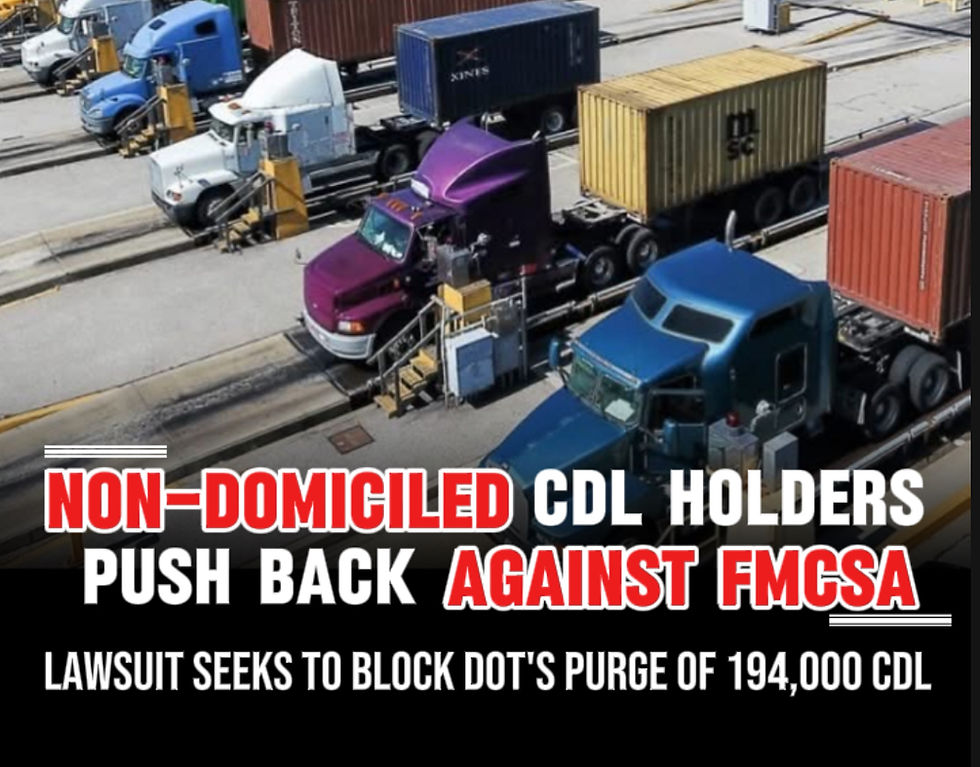
Drivers with a non-domiciled commercial driver's license (CDL), meaning those living outside a U.S. state, but working here, are pushing back after the Federal Motor Carrier Safety Administration launched sweeping audits and tighter rules. The new regulations limit eligibility, shorten license validity, and demand stricter immigration-status verification.
Public Citizen, representing DACA recipient Jorge Rivera Lujan, asylum seeker Aleksei Semenovskii, the American Federation of State, County and Municipal Employees (AFSCME), and the American Federation of Teachers (AFT), has filed a petition on October 20th, 2025 in the D.C. Circuit challenging both the content of the rule and the FMCSA’s failure to follow legally required rulemaking procedures.
Wendy Liu, an attorney with Public Citizen Litigation Group, said the rule unfairly targets individuals authorized to work in the U.S. “This regulation seems aimed at sidelining lawful workers based on prejudice,” Liu said. “We’re asking the court to overturn it before it harms countless drivers who depend on their CDLs for their livelihoods.”
The FMCSA announced an Interim Final Rule (IFR) on September 26, 2025 (published in the Federal Register on September 29, 2025) titled “Restoring Integrity to the Issuance of Non-Domiciled Commercial Drivers’ Licenses (CDL).” The rule was triggered by a nationwide audit of state driver-licensing agencies that found significant compliance problems in six states (California, Texas, Colorado, Pennsylvania, South Dakota and Washington) issuing non-domiciled CDLs in ways inconsistent with federal rules. Among the problems cited: CDLs issued to drivers whose immigration/work authorization had expired; CDLs issued to applicants without sufficient verification; CDs valid far beyond the holder’s lawful presence in the U.S. FMCSA and DOT (the United States Department of Transportation) say this is a public-safety problem: “the process for issuing these licenses is absolutely 100 % broken.”
What the new rule changes
Key changes in how non-domiciled CDLs/Commercial Learner’s Permits (CLPs) are issued and renewed:
Eligibility narrowed: only certain non-immigrant visa categories (H-2A, H-2B, E-2) will be eligible for a non-domiciled CDL. Work permit (EAD) alone is no longer sufficient. Must present an unexpired foreign passport and Form I-94/I-94A at every issuance, transfer, renewal. The expiration of the CDL/CLP must match the expiration of the I-94 or one year, whichever is sooner. The state driver licensing agency must verify immigration/work-authorization status using the federal SAVE system. States must pause (or have paused) issuance of non-domiciled CDLs until they comply with the new standards. For existing non-domiciled CDLs, the rule indicates state agencies may need to review and possibly revoke/reissue those that don’t meet new criteria.
Why this matters (and what’s at stake)
The FMCSA estimates ~200,000 non-domiciled CDL holders exist, representing roughly 5 % of active interstate CDL holders (estimated ~3.8 million). Under the new rule, many of those holders may not be eligible for renewal, gradually reducing that pool. States face consequences: for example, California was warned that if it does not comply, it risks losing federal highway funding (~$160 million in the first year) and even decertification of its CDL program. For trucking companies, this means they need to review their hiring and driver-credential verification practices to ensure compliance. Non-compliant drivers could lead to liability, regulatory penalties, or operational disruption.
Push back and legal concerns
Some of the holders of non-domiciled CDLs and advocacy organizations have raised concerns that the rule may disproportionately affect immigrant drivers who are legally working in the U.S. but hold visas or work authorizations not in the newly-eligible categories (e.g., asylum seekers, certain EAD holders). It may raise civil-rights issues, including employment discrimination or deprivation of authorizable employment based on immigration status rather than driver safety record.
FMCSA itself acknowledged in the IFR that it “does not have sufficient evidence, derived from well-designed, rigorous, quantitative analyses, to reliably demonstrate a measurable empirical relationship between the nation of domicile for a CDL driver and safety outcomes,” meaning the rule is not strictly supported by large-scale statistical crash/injury data differentiating non-domiciled vs domiciled drivers.
In other words: while safety concerns are cited, the evidence base underlying the rule is contested by some.


They need to learn English that is the law
I thought no one would care about us , hope this mess gets sorted out soon
Wow
Damn